ORIENTAL RUG PRODUCING AREAS


NORTHEAST CHINA

 
PAKISTAN                                                        INDIA


TYPES OF ORIENTAL RUG CONSTRUCTION

WHO USES WHICH KNOT?


Line of division (dotted line): distinguishing Turkish Knot (west of line) and Persian Knot areas (east).


The ADVANTAGES of Ownership -
ORIENTAL RUGS
THE TOP 10 REASONS FOR PURCHASING AN ORIENTAL AREA RUG:

  1. Truly a Work Of Art
  2. Still Made By Hand
  3. Good Resale Value
  4. Long Life Expectancy
  5. Greatly Enhances Room & Furniture
  6. Organizes Space
  7. Organic - Made With Natural Fibers
  8. Absorbs Sounds (Dampens Echo)
  9. Cushions Falls (Potential safety factor)
  10. Can Stay in Family for Generations

     
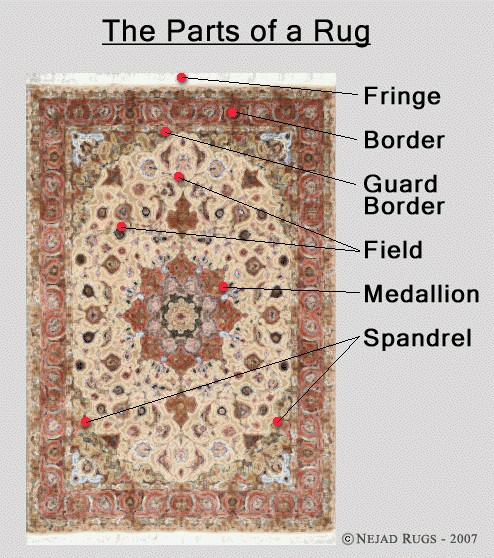
THE PARTS OF A RUG

  1. WARP - The parallel threads running through the entire length of the rug onto which the knots are tied.
  2. WEFT - The threads running across the width of the rug inserted between all the rows of knots. These threads pass through alternate warp threads. Their job is to secure the knots in parallel lines and to strengthen the fabric.
  3. KNOT - The term used for a strand of wool yarn which is looped around two adjacent warp threads and then cut to form the pile (surface of carpet).
  4. OVERCASTING - A simple wrapping of dyed yarn along the entire length of both sides of a handmade rug.
  5. FRINGE - The visible continuation of the warp threads at both ends of the carpet.
  6. KILIM - The pileless web of warp and weft between the rug's pile and the knotted fringe. This is also the name for a rug without pile.

PERSIAN KNOT
WITH ALL OF THE WARP THREADS ON ONE LEVEL

TURKISH KNOT
WITH ALL OF THE WARP THREADS ON ONE LEVEL

PERSIAN KNOT
WITH THE WARP THREADS ON TWO DIFFERENT LEVELS

  OPEN BACK
  CLOSED BACK           
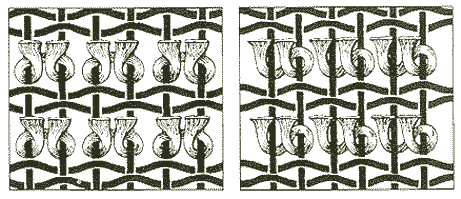
The FULL LOOP part of the KNOT is on the UPPER warp thread
  • TRADITIONAL PERSIAN KNOT USED IN INDIA, PAKISTAN, CHINA, IRAN (except western part)
  • IDEAL FOR 1/4, 3/8, or 1/2 PILE
  • MAKES MORE FLEXIBLE RUG
  • SPECKS of WEFT SHOW FROM THE BACK OF RUG (normally white)
 In the CLOSED BACK KNOT the FULL LOOP is on the LOWER warp thread
  • ONLY USED IN CHINA
  • CONCEALS WEFTING (No white specks visible from back of rug)
  • IDEAL FOR VERY THICK RUGS
  • TAKES A THICKER YARN
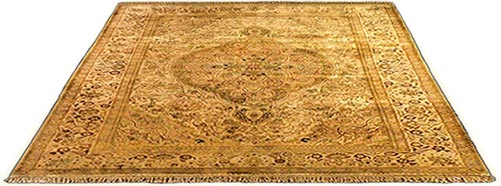
EXAMPLE OF AN OPEN BACK & A CLOSED BACK ORIENTAL CARPET.
DIFFERENT METHODS FOR FINISHING THE UNDERSIDE OF A RUG

FLAT-WOVEN RUGS


Flat-woven rugs have been made in many area for thousands of years. The designs come from the dyed wefts. There are no knots and therefore no pile. They are generally less expensive and less durable than knotted rugs. Flat-woven rugs are lightweight, easy to handle and normally reversible. A favorite of many decorators.

COMMON METHODS OF CHANGING COLORS

        SLIT WEAVE       WARP SHARING (DOVE TAILING)    INTERLOCKING WEFTS


            SOUMAK WEAVE                               FLAT-WEAVE CIRCLE FORMATION


HAND TUFTED RUGS
(Also known as Tientsin, Full Cut, or Latex)

Illustration and Diagram showing the steps involved in the production of a hand-tufted rug.
The hand-tufted rug looks and feels very much like a hand-knotted rug. This is because it uses the same fine wool and dyes as the fine knotted rugs use. It differs in the construction method. Instead of tying each knot by hand, the tufted rug is made with a tufting gun (B) from the back of the rug. (Rug hooking is similar but done from the front.) This method saves a lot of time and keeps the price of the rug much lower than a knotted rug of equal size.

CONSTRUCTION STEPS

1.) Stretch foundation cloth (A) onto loom
2.) Ink design onto this same cloth
3.) Gun tuft the wool yarn (C) from the back of the cloth as shown above (D)
4.) Finish entire design changing yarn color as needed
5.) Take rug off loom and place it face down on floor
6.) Place scrim (F) upon back and apply layer of latex (E)
7.) After latex dries, shear face (G), wash and emboss
8.) Sew on the back cloth (H). (Protects floor surface from the roughness of the latex and scrim.)
9.) Sew on fringe.

Amazing But True!

  1. Nejad Oriental Rugs use the same methods & materials used for thousands of years.
  2. The average weaver ties more than 10,000 knots a day ... each one by hand.
  3. A room size Oriental rug takes many months to make. Some oriental rugs have taken years to complete.
  4. One good quality room size rug uses a flock of sheep for its wool.


Photo of sheep indicating the shoulder section of wool to be harvested for use in the making of a high quality rug.
FROM SHEEP TO RUG

Diagram of the steps involved in the processing of wool into the finished rug product.

WOOL
THREE FACTORS THAT DETERMINE OR INSURE QUALITY:

  1. SPECIAL BREED -
    • OUT OF 952 BREEDS OF SHEEP - ONLY A SELECT FEW QUALIFY TO MEET THE QUALITY REQUIREMENTS OF THE WOOL USED IN THE PRODUCTION OF FINE RUGS

  2. PROPER RAISING OF SHEEP -
    • A SPECIAL DIET AS WELL AS OPTIMAL CLIMATE AND ALTITUDE ARE PROVIDED AS ESSENTIAL FACTORS INFLUENCING THE QUALITY OF THE WOOL.
    • THE AGE OF THE SHEEP AS WELL AS THE TIME OF THE YEAR SHEARING OCCURS ARE ADDITIONAL IMPORTANT FACTORS.

  3. SPECIAL SECTION OF FLEECE -
    • ONLY THE BEST SECTION OF THE SHEEP'S FLEECE IS USED FOR EACH RUG.
    • THE SHOULDER WOOL IS THE LONGEST AND MOST EXPENSIVE.
    • SHOULDER WOOL GIVES THE RUG'S WOOL EXCELLENT STRENGTH, LUSTER, RESILIENCE, SOFTNESS AND DURABILITY. A FINE PIECE OF ART WORK DESERVES NOTHING SHORT OF THE FINEST MATERIALS.


Diagram of six Wool processing steps - 'A' through 'F':
WASHING, SORTING, CARDING, COMBING, SPINNING, PLYING.
WOOL PROCESSING STEPS: WASHING, SORTING, CARDING, COMBING, SPINNING, PLYING


CHARACTERISTICS OF WOOL

WOOLEN YARN
IS SPUN AFTER CARDING
WORSTED YARN
IS NOT ONLY CARDED BUT IS GIVEN EXTRA COMBING TO REMOVE SHORTER FIBERS
'S' and 'Z' TWISTS
SHOW DIRECTION YARN IS SPUN
THE AMOUNT OF TWIST IN YARN
DETERMINES THE STRENGTH. NO TWIST SHOWS THE FIBERS PARALLEL; THIS IS VERY SOFT WEAK YARN. WITH MORE TWIST IN THE YARN, IT BECOMES STRONGER AND HARDER.
CROSS SECTION OF A WOOL FIBER
THE MEDULLA IS FOUND ONLY IN COURSE WOOL.
SINGLE WOOL FIBER
SHOWING ITS NATURAL CRIMP WHICH GIVES WOOL ITS WONDERFUL RESILIENCE.


COTTON

Although wool is the best material for the rug's pile, it is not a good choice for the foundation (warp & weft). A rug made with a wool foundation will not lie flat and will be crooked (especially after washing). Only the nomadic tribes still use wool for foundations, mainly because they do not own land nor stay in one place long enough to grow cotton. Cotton makes the best foundation. Silk makes a good warp thread if extreme thinness is desired.

A wool foundation can be recognized by its fringe which is darker and thicker than a cotton fringe (warp).

The ADVANTAGES Of A
COTTON FOUNDATION

  1. Stronger
  2. Thinner
  3. Limited Stretching
  4. Even Shrinkage
  5. The Rug Will Keep It's Shape
  6. The Rug Will Lie Flat


DYES

FOUR TYPES OF RUG DYES

NATURALANILINEACIDCHROME
  1. Oldest
  2. Color Change
  3. Fewer Colors
  4. Inconsistent
  5. Hard on Wool
  6. Duller
  7. Fades in Light
  1. Corrosive
  2. Colors Faded
  3. Colors Ran
  4. Ruined Many Fine Rugs
 - (Developed in 1856 - Obsolete)
  1. Cheap
  2. Colors Run
  1. Resists Acids, Alkalis, Washing & Light
  2. Won't Harm Wool
  3. Over 600 Colors
  4. Colors are Fast
  5. Won't Run or Streak
  - (Developed in 1920's & 30's)

Today's synthetic (chrome) dyes are excellent and are not to be confused with the earlier unsatisfactory synthetic (aniline) dyes of the past.


THE RUG DESIGN PROCESS

Illustration of a Cartoon (a full scale visual chart) and Talim cards (hand-written verbal description).

CARTOON    
A cartoon is a full scale graph paper chart which indicates to the weaver the color for each knot. Every knot is represented by a tiny square.
TALIM
In some weaving districts talim cards are used instead of a cartoon. One person reads the color and number of knots to several weavers.

Four criteria used for determining a machine made rug.

HOW TO RECOGNIZE A MACHINE MADE 'ORIENTAL DESIGN' RUG

  1. Machine stitching can always be found along both sides of the rug.
    The stitching is normally dyed to make it less noticeable.
  2. The design is often vague and indistinct.
  3. The back is covered with perfectly straight lines.
  4. The fringe is almost always sewn on and not an extension of the warp.


ORIENTAL RUG LOOM
Illustration showing an Oriental rug loom and description of individual features of the loom.
ILLUSTRATED ORIENTAL RUG LOOM


DIFFERENT LOOM TYPES


1. HORIZONTAL (NOMADIC, GROUND)


2. VILLAGE (VERTICAL)         3. TABRIZ                2. ROLLER BEAM    


HOW AN ORIENTAL RUG LOOM WORKS


Sculpturing: Carving and incising the rug surface.      


VALUE/COLOR PERCEPTION: RUG PILE DIRECTION AND LIGHT REFLECTION


The ADVANTAGES of
CHEMICAL WASH

  1. Imparts Sheen
  2. Moth Proofs
  3. Softens Colors
  4. Removes Dirt and any Excess Dyes
  5. Makes Rug more Stain and Soil Resistant
  6. Removes Loose Fibers


COUNTING KNOTS CORRECTLY

Counting knots on an oriental rug is easy to learn. Unfortunately most "expert" knot counters do not realize one knot is often counted as two knots and with the use of unplyed strands of yarn, one knot has been mistaken for eight knots or more! We must first learn what one knot looks like from the rug's back.

On the back of a handknotted rug you will see thousands of tiny squarish "bumps" (see page at right). We must learn the relationship between these "bumps" and the knots. These squarish "bumps" are the visible parts of the knots that loop around the warp threads as shown below.

Every Persian and Turkish knot has two loops but only some rugs show both. Most rugs show only one of the loops. A few rugs show one loop but just part of the other loop.

Before counting knots we must be sure we are counting each knot only once.

RUG KNOTS THAT SHOW TWICE (ONE WARP LEVEL)

WHY TWICE?
When all the warp threads are on the same level, both loops (bumps) show from the back of the rug as shown here.

WHICH RUGS DO THIS?
All Pakistan Bokharas & tribal rugs from Iran, Turkey, Afghanistan, etc.

HOW TO SPOT
Each "bump" will always have an identical twin "bump next to it.

RUG KNOTS THAT SHOW ONCE (TWO WARP LEVELS)

WHY ONCE?
When there are two layers of warp threads, one of the two knot loops goes "upstairs" and out of view as shown here.

WHICH RUGS?
Chinese, Indian and many other rugs do this.

HOW TO SPOT
Look around for single "bumps" that do not have the identical bump next to them.


QUALITY GRADING SYSTEMS

China, India and Pakistan each use their own unique system for grading rug quality by knot count. Handmade rugs from any country (except China) are often graded by "knots per square inch".

Remember that Indian, Chinese, and Persian design Pakistan rugs show each knot only once, but the Pakistan Bokhara rug shows each knot twice. Try these systems on real rugs. Not only are they easy to learn, but you'll feel like a "rug expert".

 China


All Chinese rugs are graded by "line count". Common line counts include "70 line", "80 line" and "90 line". These numbers simply tell us how many knots are in a foot of the carpet's width. A "100 line" rug has 100 knots in one linear foot across the width of the rug. No other country uses this system.


ONLY CHINESE RUGS USE THE "LINE COUNT" SYSTEM SHOWN IN ABOVE CONVERSION CHART


 India


 Pakistan


Amazing But True!

A Chinese 90 line 9 x 12 rug has more than 10 miles of warp and weft threads in its foundation!
  • Warp: 21,060 ft.
  • Thin Weft: 25,952 ft.
  • Thick Weft: 9,720 ft.
  • Kilim: 360 ft.
  • TOTAL: 57,092 ft.


= = = TURKISH / PERSIAN Knot Line     IRAN & CENTRAL ASIA    


TURKEY


THE CAUCASUS


TWO COMMON RUG TERMS

JUFTI KNOT: A 'False' knot, either Turkish or Persian, which is tied onto four warp threads instead of the normal two. This time-saving knot lessens the quality and the amount of material in a rug.


JUFTI KNOTS: TURKISH (left)   PERSIAN (center, right)

ABRASH: Variations in the shade of a single color appearing on horizontal lines across an Oriental rug owing to Dyes being applied unevenly or using wool from different dye lots (this effect may be achieved intentionally).

                   
3 EXAMPLES OF THE ABRASH EFFECT

Five Ways To Care For
YOUR ORIENTAL CARPET

  1. For day to day cleaning, your vacuum will do an excellent job of removing surface soil. It is advisable to use your vacuum attachments to reach under furniture for protection against moths, a potential threat to the lifespan of your Oriental carpet.
  2. If you should spill a liquid, use white paper towels to soak up excess moisture; then wet, rinse and blot again, raising the wet area until dry. For food spills, try to remove as carefully as possible with a dull knife, then follow the same steps as for liquids.
  3. If you should have to store your carpet for any length of time, take care to pack your Oriental with moth repellents, and wrap in strong paper.
  4. When arranging your furniture, it's wise to have some sort of protection under the legs to prevent the carpet fibers from being crushed.
  5. Lastly, most Orientals benefit from a professional washing every few years, but send them only to an expert who understands the care and extra attention they require.


RUG NAMES CATEGORIZED BY REGION
Names (styles/types) originating from Persia:

Western IranN.E. Iran (Azerbaijan)Central Iran Southern IranEastern Iran
  • ARAK
  • AINABAD
  • BIBIKABAD
  • BIJAR
  • BORCHALOU
  • DERGAZINE
  • FARS
  • FERAGHAN
  • HAMADAN
  • HUSSEINABAD
  • INGELES
  • JOZEN
  • KABUTARAHANG
  • KURDISTAN
  • LILIHAN
  • LURISTAN
  • MAHAL
  • MALAYER
  • MAZLAGHAN
  • MEHRIBAN
  • MIR-SARABAND
  • MOSUL
  • MUSHKABAD
  • SARABAND
  • SAROUK
  • SENNEH
  • SULTANABAD
  • TAFRESH
  • ZAGHEH
  • ZENJAN
  • AROABIL
  • AHAR
  • BAKSHAISH
  • GORAVAN
  • HERIZ
  • KARAJE
  • MEHRIVAN
  • MESHKIN
  • SENNABAFF
  • SERAB
  • SOUJBOULAK
  • TABRIZ
  • ABADEH
  • AFSHAR
  • BAKHIARI
  • FARS
  • GABEH
  • KERMAN
  • NIRIS
  • QASHQA'I
  • RAVAR
  • SHIRAZ
  • YALAMEH
  • YEZD
  • BALUCHI
  • BIRJAND
  • KHORASAN
  • MESHED
  • MUD
  • TURKBAFF

Names (styles/types) originating from areas other than Persia:

Turkey
Asia Minor, Anatolia
CaucasusCentral Asia E. TurkestanRomanian
w/knots per sq"
  • AKHISAR
  • ANATOLIA
  • BASMAKCI
  • BERGAMA
  • CANAKKALE
  • DISEMEALTI
  • EZINEH
  • GHIORDES
  • HEREKE
  • KAYSERI
  • KIRSHEHIR
  • KONYA
  • KULA
  • LADIK
  • MAKRI
  • MELAS
  • MUDJAR
  • OUSHAK
  • SIVAS
  • SMYRNA
  • SPARTA
  • TRANSYLVANIA
  • YAGCIBEDIR
  • YAHYALI
  • YURUK
  • ARMENIAN
  • BAKU
  • CHI-CHI
  • DAGHESTAN
  • DERBEND
  • ERIVAN
  • GANJE
  • KABISTAN
  • KARABAGH
  • KAZAK
  • KUBA
  • SHIRVAN
  • SOUMAK
  • TALISH
  • ZE1KHUR
  • AFGHAN
  • BALOUCHI
  • BESHIR
  • CHODOR
  • DAULATABAD
  • ERSARI
  • HERATI
  • KARAKALPAK
  • KAZAKH
  • KHIVA
  • KIRGHIZ
  • PENDE
  • SALOP
  • SAMARKAND
  • SARYK
  • TEKKE
  • TURKOMAN
  • UZBEK
  • YOMUD
  • KASHGAR
  • KHOTAN
  • YARKAND

    (Woolen Warp)
  • Bran-60
  • Transylvania-79
  • Brasov-103
  • Harmon-129
  • Postavarul-155
    (Cotton Warp)
  • Dorna-25
  • Bucharest-70
  • Braila-103
  • Mures-129
  • Olt-160
  • Milcov-194


THE DISTINGUISHING CHARACTERISTICS OF RUGS AND CARPETS FROM A CULTURAL & REGIONAL PERSPECTIVE

WOVEN RUGS

  • Techniques of Manufacture

    The basic techniques of rug making were first developed in the East. Traditional Oriental rugs are made on vertical looms strung with 3 to 24 warp (vertical) threads per cm (8 to 60 per inch of width. Working from bottom to top, the rug maker either weaves the rug with a flat surface or knots it for a pile texture. Pile rugs use 5- to 7.5-cm (2- to 3-in) lengths of yarn tied in Turkish (Ghiordes) or Persian (Sehna) knots with rows of horizontal weft yarn laced over and under the vertical warp threads for strength. After the carpet is completely knotted, its pile is sheared, and the warp threads at each end are tied into a fringe. The finer the yarn and the closer the warp threads are strung together, the denser the weave and, usually, the finer the quality. Fine-textured and valuable rugs have 62 or more knots per sq cm (400 per sq in) ; coarse-textured rugs may have less than 8 per sq cm (50 per sq in). In traditional Scandinavian weaving (rya) the knot is actually tied like the Turkish knot, but the pile alone is 5 to .5 cm (2 to 3 in) long, and the rows of knots are separated by 10 to 20 weft rows.

    Flat-woven rugs are lighter in weight and less bulky than pile rugs. The best-known and earliest type is the kilim, which has plain weave made by shooting the weft yarn over and under the warp threads in one row, then alternating the weft in the next row. The soumak type is woven in a herringbone pattern by wrapping a continuous weft around pairs of warp threads.

  • Materials and Motifs

    The same materials are used in flat-woven and pile rugs. Warp and weft yarns are either wool or cotton. In pile rugs, the knots are usually wool, sometimes goat's or camel's hair, depending on the region. Silk, traditionally a costly material, is found principally in fine Persian carpets and some Chinese rugs. Yarns have been used in their natural colors or colored with dyes extracted from flowers, roots, and insects. Colors, available in a wide spectrum, often have had symbolic as well as decorative importance, especially in Oriental rugs. Despite the existence of distinctive regional styles and motifs, many designs are common to diverse regions in the East and even in the West. These designs may be rectilinear or curvilinear, naturalistic or abstract; they may be based on motifs such as the sun wheel, the tree of life, the cloud band of China, the pear-shaped figure (boteh) that heralds the Islamic paisley design, flowers of all kinds, animals, birds, and insects. Muslim prayer rugs are always distinguished by the prayer niche (mihrab) woven into the pattern; this represents the actual prayer niche in the Great Mosque at Mecca, toward which the rug must point during use.

OTHER TYPES OF RUGS

In the West, rugs have been made by several other techniques as well. For hooked rugs, thin strips of outworn woolen goods traditionally were drawn through a linen, cotton, or burlap backing with a metal hook to form slightly raised loops on the surface. Later on, yarn was also used for hooking. Favorite designs of early-American hooked rugs included flowers, geometrical and abstract patterns, and pictorial scenes with landscapes and animals. For traditional braided rugs, strips of outworn cloth were plaited together and then wound flat in a circle or oval. In patchwork rugs, snippets of cloth were sewed on homespun woolen material. In Shaker rugs, cloth scraps were threaded together like a necklace and then sewed onto a strong backing material. In needlepoint rugs, each intersection of a mesh canvas backing is covered with individual stitches of wool yarn.


RUGS AROUND THE WORLD

Rugs are mentioned in the Old Testament and in Homer; they were known to the ancient Chinese, the Egyptians, and the Greeks. The earliest-known hand-knotted carpet, dating from about 500 BC, was discovered well preserved in ice in a tomb at PAZYRYK, in southern Siberia. Rugs were made in Persia during the reign of Cyrus (549-530 BC), whose tomb was said to have been covered with precious carpets. By the l6th century, traditions of rug making were highly developed in Persia and Turkey. Rug making then spread north to the Caucasus and east to India, Turkistan (Turkestan), and China; finally, it reached Europe and the West. The American Indians developed weaving traditions independently.

  • Persia and India

    A graceful, curvilinear style and a masterful use of color is typical of Persian rugs. The great tradition of rug making culminated in the 16th and 17th centuries in densely woven court carpets of the Safavid period. Usually classified according to the particular type of design displayed in each, they include medallion carpets, whose large central medallion patterns are embellished with flowers; garden carpets, incorporating flowerbeds, paths, and often even canals and pools; flower carpets; vase carpets, in which an ornamental vase holds flowers and vines; animal carpets; and hunting carpets, portraying a favorite royal sport.

    Regional and village carpets of Persia most often use the central medallion design or all-over pattern of flowers or other flowing forms; they are usually but not always more coarsely woven than court carpets. Regional carpets are usually designated by their place of origin, such as Bakhtiari, Sijar, Feraghan, Hamadan, Herez, Isfahan, Kashan, Kerman, Khorassan, Kurdistan, Sarouk, Sehna, Shiraz, and Tabriz.

    The golden age of Indian rug making occurred under the Mogul emperors who ruled from the mid-16th to the mid-17th century and who imported not only designs and traditions from Persia but weavers as well. The greatest Indian examples were the finely woven florals and the hunting carpets, with their remarkably naturalistic designs.

  • The Caucasus

    Caucasian rugs are made by various tribes in the mountainous district between the Black and Caspian seas. The designs are often dense all-over patterns of geometric elements — squares, diamonds, stars, and frets — or motifs drawn with angular lines in bold, clear colors. The rugs are generally small, with wide multiple borders. The best known include the Baku, Chichi, Daghestan, Kabistan, Kazak, Kuba, Shirvan, the flat-woven Soumak, and the Karabagh, with an unusual floral design of Persian influence. The Armenian dragon carpet, combining an ancient dragon motif with Persian flowers, was made during the 15th and 16th centuries and was much more opulent than the better-known yet simpler Caucasian rugs.

  • Turkey

    Turkish carpets were the first Orientals to be imported into Europe and often appeared in late-Renaissance paintings; Hans Holbein the Younger painted a particular type so often that it came to be called a Holbein. Most were woven in villages in Anatolia (the part of Turkey that lies in Asia Minor) in bright, rich colors with geometric forms such as the star and diamond as well as linear floral forms. In the mid-16th century, elegant court rugs woven on royal looms in Constantinople incorporated the more graceful curvilinear style of Persia. One well-known type was the Star Ushak, with its distinctive star-shaped medallions.

    Turkish prayer rugs are of particular interest. The mihrabs usually have pointed arches and stepped sides, and the field is sometimes ornamented with a hanging lamp or candlesticks. The best known are the Ghiordes, with freestanding columns supporting the mihrab; Ladik, with its stylized tulips; Kula; Konya and Mudjur. Regional carpets with primarily geometric designs include the Bergama and Yuruk.

  • Central Asia and Turkistan

    Carpets made by the nomads of central Asia are collectively designated as Turkoman carpets. These carry a number of names including Afghan, Baluchi, and Bokhara, the last comprising Royal (Tekke), Pendeh, Yomud, and Beshir carpets. The geographic and cultural isolation of the region accounts for the distinctive character of the rugs. Most are reddish and have a geometric design that incorporates, in an all-over pattern, the coat of arms (gul) of the individual tribe.

    Samarkand, although actually a collection and marketing center rather than a rug-producing center, is the name applied to the rugs produced more than 300 km (about 200 mi) away in Kashi (Kashgar) , Hotan (Khotan) , and Yarkant (Yarkand) in what is now far western China. The Samarkand style is less angular than the Turkoman style and not as graceful as that of Chinese rugs. The principal design motifs are medallions in the shape of flattened circles, a pomegranate tree growing out of a vase, and such Chinese figures as bats, butterflies, and frets.

  • China

    Simplicity of design, serenity of composition, a limited range of subdued and harmonious colors, and symbolic motifs characterize Chinese carpets., The earliest surviving examples are from the late Ming dynasty in the mid-17th century; they are decorated with simple arrangements of geometric forms, typically a medallion, sometimes with a dragon, and repeat patterns. Rugs of the Kangxi (K'ang-hsi) period (1662-1722) continued Ming forms with greater naturalism and more ornamentation. From the late 17th century onward, the Chinese have woven the unique pillar rugs designed to encircle the columns of palaces and temples during festivals. During the latter half of the 18th century ornate and opulent palace rugs, the design of which was greatly influenced by the floral patterns of Persia, were woven. Rugs for export followed, favoring a central dragon motif or ornate floral designs. At the end of the 19th century, anilines replaced natural dyes and introduced an often harsh and garish quality to the once-harmonious color schemes.

    Frequently recurring designs in Chinese rugs include geometrics such as the familiar meander or key border and fret; animals, including various dragon forms, the Fu dog, storks, cranes, butterflies, and bats; realistic and identifiable flowers, each with its symbolic meaning; Taoist and Buddhist symbols; natural forms including clouds, water, and mountains; the Chinese character shou, the symbol for long life; and the many permutations of round medallions.

  • Spain

    Rug making was introduced (AD 711) to Spain by the invading Moors. Their rugs first incorporated the geometric forms of Islamic art; later, combined Muslim and Christian motifs were used, particularly heraldic motifs, as in the well-known Admiral carpets woven for the heirs of Spanish admirals. After the 18th century the best Spanish rugs were the low-looped, folk-art Alpujarras made by the peasants in the mountain district of southern Spain.

  • France

    The best-known French rugs are the AUBUSSON, a flat tapestry weave, and the Savonnerie, a knotted pile or tufted weave. Aubusson rugs had been woven for 9 centuries when, in the early 17th century. Henry IV established court looms in the Louvre to produce Oriental-type pile carpets. These rugs came to be called Savonnerie for the soap factory (savonnerie) that housed the looms for a time. The designs of both types reflected contemporaneous French art styles.

  • England

    The English rug industry, developed in the 16th century, was invigorated by the French Protestants, many of them weavers, who fled to England for religious asylum after the Edict of Nantes was revoked. Early carpet works at Wilton and Axminster wove pile carpets in which bright floral patterns predominated. The great industrial advances of the 18th century — the spinning jenny, power looms, Jacquard weaving — revolutionized carpet making and affected design as well as production. Reacting against the machine technology and Victorian taste, the 19th-century ARTS AND CRAFTS MOVEMENT, led by William Morris, emphasized handcrafts and original design in the decorative arts.

  • Scandinavia

    Scandinavia's unique shaggy pile weavings, called rya, were first woven as a defense against the harsh northern climate. Early designs were simple geometrics; later ones included ecclesiastical and folk motifs such as stars, wheels, flowers, and trees. Although folk rya declined in the 19th century, it is currently flourishing as an art form, especially in Finland.

  • Navajo Rugs

    Typical Navajo weavings repeat a few simple geometric shapes — stripes, rectangles, zigzag lines, diamonds — in minimal designs using primarily natural-colored wools (usually black, gray, tan, or brown) in a flat tapestry weave. The westward expansion of the railroad in the 1880s introduced commercial yarn and aniline dyes (replacing vegetable dyes). Among notable contemporary Navajo designs are those produced at Chinle, Arizona, and at Two Gray Hills and Ganado, New Mexico.

Contemporary Trends

More than 97 percent of all machine-made carpets are now made of synthetic fibers, principally nylon. Area rugs are also fashionable; these, in both contemporary and period designs, are often made of natural fibers like sisal or of hand-tufted wool in natural colors. Various textures are used, among them surfaces that are sculptured or cut to different levels and areas of both cut and uncut loops. Many contemporary artists design pile or flat-weave rugs and wall hangings. Durable synthetic fibers are also used outdoors on patios, on boats, and around pools.


MAJOR CARPET CENTERS OF THE EAST


REFERENCE MAP FOR MAJOR CARPET CENTERS OF THE EAST

CHINAIRANINDIA PAKESTAN
  1. Kashgar
  2. Yarkant
  3. Khotan
  4. Aksu
  5. Urumqi
  6. Boatou
  7. Beijing
  8. Tianjin
  9. Qingdao
  10. Shanghai
  1. Tabriz
  2. Ahar
  3. Mishkin
  4. Heriz
  5. Ardebil
  6. Bijar
  7. Kazvin
  8. Kalar Dashi
  9. Teheran
  10. Varamin
  11. Senneh
  12. Hamadan
  13. Feraghan
  14. Qum
  15. Kermanshah
  16. Malayer
  17. Kashan
  18. Isfahan
  19. Abadeh
  20. Shirez
  21. Yazd
  22. Kerman
  23. Birjand
  24. Mashhad
  25. Baluchi Region
  1. New Delhi
  2. Jaipur
  3. Agra
  4. Bhadohi Region
  1. Karachi
  2. Lahore
  3. Peshawar

Major Carpet Centers (Continued)

TURKEYTURKESTANAFGHANISTAN CAUCASUS
  1. Hereke
  2. Bergama
  3. Kosak
  4. Ghiordes
  5. Kula
  6. Izmir
  7. Milas
  8. Yalcibedir
  9. Ladik
  10. Kirsehir
  11. Kars
  12. Yuruk Region
  1. Khiva
  2. Bukhara
  3. Kerki
  4. Samarkand
  5. Tashkent
  1. Herat
  2. Maimana
  3. Alubolak
  4. Aksha
  5. Mazar-i-Sharif
  6. Karkin
  7. Kunduz
  8. Kabul
  1. Lenkoran
  2. Saliani
  3. Baku
  4. Akstava
  5. Gendje
  6. Fachralo
  7. Borjalu
  8. Soumak
  9. Chichi
  10. Kuba
  11. Derbent


AN INTRODUCTION TO THE ART & PRODUCTION OF HANDMADE ORIENTAL AREA RUGS FROM BOTH A HISTORICAL & CONSUMER PERSPECTIVE

Introducing you to the exciting world of handmade oriental rugs - a world of timeless beauty and cultural mystique that has remained virtually unchanged for centuries. The information offered provided here is both provides the reader with both a general understanding of the origin and the creation of an oriental rug, as well as some of the advantages of including these handcrafted rugs in your decorating plans for your home, office, or wherever a floor covering is needed.

While a variety of weavings are mentioned in ancient writings, the origin of handwoven oriental rugs is uncertain. The earliest surviving piece, known as the Pazyryk carpet, dates back to about 400-500 B.C. Discovered in a burial site excavated in southern Siberia in 1947-49, it is now part of the Hermitage Museum Collection in Leningrad.

Dramatic changes have occurred in today's handmade oriental carpet industry. Although weaving techniques and traditions have remained virtually unchanged, the weavers have found it more advantageous to adapt designs and colors to better satisfy Western decorative tastes. Moreover, throughout the 1980s, the production of Persian-design carpets in other countries, particularly India, China, Pakistan, and Rumania has increased significantly, offering consumers an ever-wider range of color and design choices available in a full range of prices.

What exactly is an oriental rug? As defined by the Oriental Rug Importers Association, Inc., an oriental rug is "... handmade of natural fibers (most commonly wool or silk), with a pile woven on a warp and weft, with individual character and design made in the Near East, Middle East, Far East, or the Balkans."

An oriental rug is handwoven and varies in quality. Quality is generally determined by the wool, intricacy of design, and knot density. Wool quality is defined by the length of its fibers, springiness, and luster. Today, the wool used in handknotted oriental rugs either originates exclusively from the country of origin or is a blend of indigenous and imported wool. Intricacy of design refers to the degree of detail a design possesses as well as to the number of different colors needed to execute the pattern. The more complex the design, the more experienced the craftsman must be to weave the pattern. Finally, knot density and fineness of weave are synonymous. The more knots tied per square inch, the finer the detail in the design and the more labor-intensive the production.

While machine-made carpets are manufactured to machine-like tolerances, handmade rugs reflect the human element — the individual's own interpretation of color and design — which is the essence of their beauty and singularity. In the following pages, you are invited to discover the fascinating, exotic world of oriental rugs and to see for yourself how their use enriches your decorating plans.


UNDERSTANDING THE PRINCIPLES OF RUG-MAKING & KNOWING WHAT TO LOOK FOR WHEN SELECTING AN ORIENTAL AREA RUG

Although some of the special techniques involved in weaving an oriental rug may vary from country to country and even from one region to another, the principles of rug-making — from dyeing the yam to shearing the finished piece — are virtually the same throughout the world and have changed very little over the centuries. Still, a basic understanding of an oriental rug's construction will be invaluable to you when selecting an oriental rug.

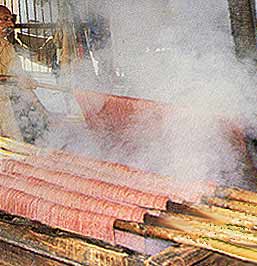
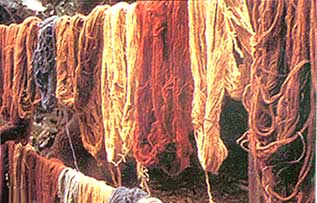
By and large, most oriental rugs feature a wool pile, mainly derived from sheep, whose quality depends on factors such as the animal's breed and diet, local climate, and shearing season. After shearing, the wool is washed, carded (i.e., a teasing process that straightens the fibers), and then hand - or machine - spun into yarn. Next, the yarn is dyed in an attractive range of colors and then dried slowly in the sun.
 
After the wool has been spun into yarn it is dyed. After being dyed, the yarn is dryed slowly in the sun.


A detailed illustration of the carpet design, most commonly called a cartoon, guides the weavers throughout the entire rug-making process. The design is rendered on graph paper to scale.
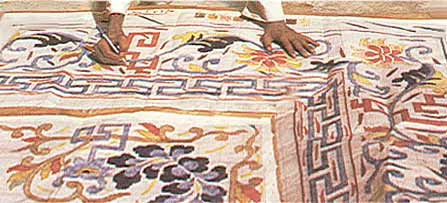
A detailed drawing of the carpet's design, which has been rendered to scale on
graph paper, is the weaver's guide throughout the entire weaving process.

Through the ages, looms have remained relatively unchanged. While the most primitive is the nomadic or horizontal loom, the type most generally used today consists of two vertical beams of either wood or metal and two similarly made horizontal beams. The distance between the vertical beams determines the rug's width. Warp threads, usually cotton, are strung between the horizontal beams at a consistent tension. The thickness of the warp threads and the closeness at which they are strung are two of the elements that will determine the fineness of the weave (i.e., knot density) of the carpet that is ultimately woven.


Turkish/
Symmetrical
Knot

Persian/
Asymmetrical
Knot

There are two types of knots used in rug-weaving: the Turkish knot (also called Ghiordes or symmetrical knot) and the Persian knot (also known as Senneh or asymmetrical knot). With the average weaver able to tie 10,000 to 14,000 Turkish or Persian knots a day, several weavers working together can only complete one or two inches of the carpet a day.
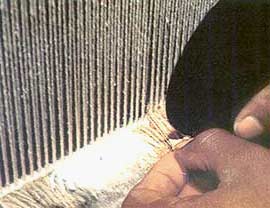
 
The weaver ties a knot around two adjacent warps, slides it down to the base of the weft and cuts the yarn with a knife. This procedure of tying and cutting creates the pile of the rug.


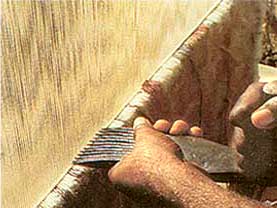
Before the actual knotting of the pile begins, the rug is secured at the bottom of the loom by a short kilim, a flat pileless fabric, which is woven by passing several rows of horizontal cotton threads, or wefts, through alternate warp threads. After rolling the different-colored yarns to be used into balls, the weaver, reading the design from the cartoon begins weaving the rug. With the appropriate color yarn, the weaver ties a knot around two adjacent warps, slides the knot down to the base of the weft, and then cuts the yarn with a knife, thereby producing the pile. After each row of knots is completed, one or more weft threads are inserted to secure the knots and are beaten down tightly with a comb. At this stage, the pile ends are often cut level with a pair of shears. The alternation of wefts with rows of tied knots is repeated until the carpet is finished. Before removing the rug from the loom, another kilim is woven at the top. The fringe is formed by the cutting of the warps at both ends of the rug.

After the rug has been cut off the loom, the final finishing steps take place. First, the selvedge edges (i.e., side edges of the rug formed by the continuous weft) are bound or overcast with yarn to reinforce the side edges of the rug. Next, the warp ends, which secured the rug to the loom, are knotted or braided to form the rug's fringe. The rug is then washed either by hand or by machine to eliminate dust and dirt that accumulated during weaving. In addition to cleaning the rug, the type of wash given the rug can also impart an exquisite sheen and luster to the wool as well as soften or antique the rug's colors.
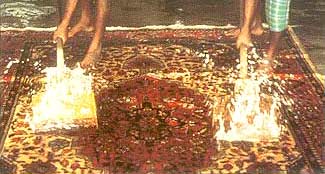
 
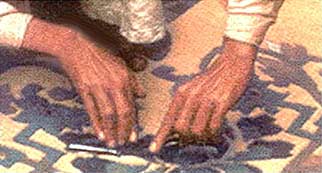
After the side edges of the rug are overcast and the fringe has been knotted the rug is washed. On certain carpets motifs are accented by carving or incising.


Once the rug is washed and dried, a carpet cutter shears the tops of the knots to create a uniform pile height. In addition to the surface shearing certain carpets feature carved or incised designs which highlight various motifs. Today, this type of accenting is often done to Chinese, Indian, and Turkish carpets. The oriental rug is now completed and ready for shipment.
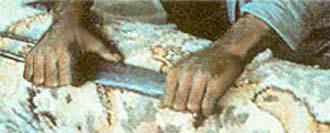


Once the weaving has been completed the rug is cut from the
loom and the surface is sheared to create a uniform pile height.

IRAN (Persia)

Known as the original home of the oriental carpet, Iran (Persia) the oldest and once the most powerful empire in the Middle East, stood at the crossroads of Eastern and Western civilizations. Under the Safavid dynasty (1502-1736), Iran attained its artistic height, and court weaving, together with the art of calligraphy, miniature painting, and tilework, flourished to exceptional heights. This brilliant era witnessed the development of highly qualified carpet factories in cities including Kerman, Isfahan, Kashan, Tabriz, and Herat (now a part of Afghanistan). Iran is the genesis of most motifs, patterns, and traditional colorations produced in rugs throughout the world today. Over the centuries, Persian carpets have become treasured heirlooms passed on from one generation to the next.

Persian carpet exports began in the 16th century. Starting in the 1850s, American, English, and German firms established new factories in Meshed, Tabriz, Kerman, and Sultanabad (now Arak), thereby ensuring the art form's continued development. Under Shah Reza Pahlavi, royal factories were established to utilize only the finest materials and methods of manufacture.

Oriental rugs have always been and are still an intrinsic part of Iranian culture and its people's daily lives. Indeed, oriental rugs are in many cases their most valued possession and are an integral part of their home furnishings. Thus, it is not surprising that current production levels throughout Iran equal if not surpass those reached prior to the Islamic Revolution of 1979. In fact, rugs are now even produced in areas where weaving was heretofore not practiced. Furthermore, Persian carpets continue to boast very high quality standards and command a very brisk interest in domestic and international markets. While large city workshops were an important factor in the past, much of today's production is fashioned along cottage industry lines in smaller villages and towns.

Persian carpets are traditionally known for their tremendous variety in design, color, size, and weave, and for the uniqueness of each and every rug produced. Rugs are generally named after the village, town, or district where they are woven or collected, or by the weaving tribe in the case of nomadic pieces. Each rug's particular pattern, palette, and weave are uniquely linked with the indigenous culture, and weaving techniques are specific to an identifiable geographic area or nomadic tribe. Such is the case, for instance, of the richly colored Bakhtiari rugs — frequently characterized by ellipse-shaped medallions with floral patterns—woven by the Bakhtiari nomads and villagers of southern Iran.

Generally smaller in size, Persian nomadic, village, and flat-woven rugs (e.g., kilims) are broadly characterized by traditional angular designs and bold as well as somber colors. Typical is the south Persian Qashqai, often finely woven and featuring a diamond-shaped medallion on a detailed background of geometric or stylized flowers. Predominant colors include reddish browns and blues. Other nomadic and village types include the Bakhtiari, Ramadan, Shiraz, Kurd, and Karaja.

IRAN
BAKSHAISH

Meanwhile, the more sophisticated carpets originating from the historic cities of Tabriz, Kashan, Kerman, Nain, and Qum feature finely woven floral patterns and complex curvilinear motifs. More elaborate pieces are often pictorial in design and depict hunting scenes, men in combat, landscapes, and historic folklore figures.

Persian carpets offer a full gamut of colorations from the pastel shades of champagne, rose, and green, typical of a Kerman for instance, to the striking reds and blues of a Heriz. This highly popular pattern is characterized by a bold and angular medallion and corner design. Just as with design, Persian colorways are a continued source of inspiration for other rug-producing countries throughout the world.

IRAN
KHOSROVABAD

The popularity of the Persian carpet, both antique and new, continues unabated. Indeed, Persian rugs shall forever be prized for their unique, individual quality. Each carpet is the product of a centuries-old cultural heritage particular to its originating village, district, or tribe. This splendid weaving tradition continues to be the chief source of inspiration for other countries of origin, including India, Pakistan, China, and Rumania.

INDIA

Carpet weaving was introduced to India during the 16th century following the Mogul conquest of Akbar the Great. Influenced by Persian culture, this Moslem dynasty established carpet factories which produced Persian-inspired weavings as well as classic Mogul carpets featuring realistic floral and pictorial renditions. For centuries, India created among the most exquisite carpets in history, mainly in Jaipur, Kashmir, Agra, and Benares. Today, many of them are guarded museum masterpieces.

With the decline of the Mogul empire and the corresponding rise of the British empire during the 19th century, the international carpet trade developed an increasing interest in India. The years succeeding World War I witnessed a significant growth in exports to the United States, initially of coarser-quality rugs featuring the French Aubusson pattern (a formal floral design) and Chinese-inspired motifs. Beginning in the 1970s the Indian rug industry, responding to an international demand for Persian-design rugs, returned to its historic Persian weaving tradition by developing and producing increasingly finer qualities of rugs. Today, the Indian weaver not only creates works which rival their Persian counterparts but which also reveal a creative ingenuity of their own.

At present, India is one of the primary sources for both pile and flat-woven rugs available in an impressive range of qualities, designs, colorations, and sizes. Indeed, Indian weavers have demonstrated a remarkable ability to adapt to ever-changing Western decorative tastes while recreating Persian rug designs at increasingly higher quality standards. As in the past, Indian weaving production is currently organized on a cottage industry basis, and the vast majority of pile rugs and flat weaves are crafted in villages throughout the Mirzapur/Bhadohi region while smaller centers are located in Jaipur, Gwalior, Kashmir, Agra, and Amritsar.

Aubusson-patterned rugs are now a minor factor in the export market, as Persian-design carpets constitute the predominant category of Indian pile rugs woven today. Thanks to the weavers' expert understanding and execution of design, coloration, and knot density, these rugs are often considered to best approximate the look, texture, and feel of their Iranian-made counterparts.

Kashan, Tabriz, Kerman, Sarouk, and Bijar are among the many popular Persian patterns that have inspired faithful recreations and innovative adaptations. The Indian weaver has mastered the rendition of these patterns in traditional Persian-style hues (e.g., dark reds and blues) and in contemporary colorations, including jewel tones and pastels, attuned to the very latest in home furnishings fashion trends. Moreover, their rugs are produced in an impressive range of qualities averaging from approximately 85 to 150 knots per square inch. Some Indian weavers' dexterity is such that they are even able to produce carpets with over 300 knots per square inch. The woolen yarns used are generally blends of Indian and imported New Zealand wool which together provide the carpet with a naturally lustrous appearance. Additionally, a small number of all-silk carpets featuring about 400 knots per square inch continue to be produced in Kashmir.

INDIA
SAROUK

The expertise of India's weavers extends beyond that of producing pile carpets. Indeed, the country is equally renowned for its production of flat weaves, notably dhurries and chainstitch rugs whose techniques are indigenous to its culture and date back possibly several thousands of years. These handcrafted flat weaves blend in with a variety of contemporary and traditional settings while offering an excellent and affordable purchasing opportunity that may be particularly appealing to the first-time buyer.

INDIA
KASHAN

Most popular in the last decade have been wool dhurries, now mainly characterized by floral designs in an array of fashionable colorations including pastels and more vibrant hues. Also available, although in lesser quantity, are cotton dhurries displaying bold geometric patterns. Chainstitch or crewel-embroidered rugs — chiefly produced in and traditionally indigenous to Kashmir — have recently experienced a tremendous resurgence in popularity thanks to their exquisitely detailed floral patterns, often European-inspired, executed in a full range of contemporary colorations.

India is a world leader in oriental rug exports thanks to its tremendous production capacity and to its weavers' dexterity, versatility, and willingness to constantly experiment with color and design combinations in an attempt to be responsive to American consumer demand. India offers a complete range of pile and flat-woven rugs in a wide range of qualities, styles, colors, and sizes. These handcrafted floor coverings are suitable for a broad spectrum of decorative specifications in residential and commercial settings alike.

CHINA

Chinese carpets were first woven centuries ago by nomadic tribes in the Sinkiang and Ninghsia regions of western China where they were used for both decorative and functional purposes. In the early to mid-19th century, this simple craft began to flourish on a much larger scale at the Imperial Court of Beijing. Particularly instrumental in developing the art was the •H patronage of Ch'ien Lung, Chia Ch'ing, and Tao Kuang, three rulers of the Ch'ing Dynasty (1644-1912).

During the mid- to late-19th century, China's entire carpet production was destined for local consumption, being sold commercially to the native noble and upper classes. Western awareness of Chinese weavings increased significantly during the Boxer Rebellion of 1900 when many palaces and residences were looted and the spoils of war were sent abroad. Chinese carpets first won official recognition at the 1903 Saint Louis International Exhibition where an entry was awarded first prize. With Western interest now kindled, substantial efforts were made to transform a cottage handicraft into a major industry in the Beijing/Tianjin area of northeastern China. In the 1920s, so-called Peking- and Tiensin-style rugs were produced according to American importers' specifications and were "all the rage" in the United States.

Following President Richard Nixon's memorable trips to China in 1971 and 1972, which resulted in the reestablishment of trade between the United States and China, Chinese carpets reemerged in the United States in 1973. They have since become a major force in the home furnishings market due to their tremendous versatility in type, style, and color, and executed with high quality control standards. Equally important has been the Chinese weavers' expertise and willingness to adapt designs and colorations to American decorative trends.

Most carpets are still woven in the northeastern provinces of China with the balance originating from the western and southern regions. Weaving is performed in factories scattered in cities and throughout the countryside. Rug production is essentially made up of autonomous provincial enterprises or cooperatives, each competing for a share of the market. The rugs are warehoused for export in the principal cities or ports of the producing provinces. Notable among the producing cities are Beijing, Tianjin, Qingdao, Shanghai, Dalian, Nanjing, Hangzhou, and Baoding.

The factories have from a few to several hundred looms, and the manufacturing process is closely supervised for quality control. While many of the looms are still built of wood, most new ones are built of steel. As they are so well built and stout, whether of wood or steel, crooked pieces are seldom produced. The carpets are woven of excellent quality indigenous wool featuring durable and resilient yarn or with a blend of native and imported wool.

Today's consumer has a wealth of patterns and colors to choose from both in pile and flat-woven rugs. The most popular design categories for pile rugs are Peking, floral, esthetic, and Sino-Persian. Peking rugs, stylistically the most indigenous to Chinese culture, generally feature a central medallion on an open or covered field of traditional and often stylized motifs and symbols, such as animals, flowers, clouds, and vases, framed by a simple, wide border. Equally in demand are floral rugs often characterized by an all-over pattern or by asymmetrically placed floral sprays. The popular Art Deco style floral carpets, based on the "Tientsin-style" rugs of the 1920s, generally feature an asymmetrical floral pattern sometimes with objects such as birds and pagodas, and wide solid-colored borders. Esthetic rugs inspired by the floral patterns of French Savonnerie and Aubusson carpets are generally characterized by a large central medallion and an open field with surrounding designs.

CHINA
PEKING

Peking, floral, and esthetic rugs' colorations are keyed to the very latest American decorative trends and range from pastels to the more vibrant jewel tones. These three rugs styles — usually carved or incised to produce depth and shading — are woven in qualities ranging from 70 to 120 lines and averaging 90 lines. This line count system is unique to China, and a 90-line rug, for instance, means that it has 90 knots in one linear foot both across the width and length of the rug and contains approximately 56 knots per square inch (90 knots times 90 knots divided by 144 inches per square foot equals 56 knots per square inch).

Undoubtedly, the most talked about category of Chinese carpets woven today is the Sino-Persian. These carpets rival their Persian-design counterparts originating in Iran, India, Rumania, and Pakistan. They are produced in qualities ranging from 120 to 300 lines, with most pieces averaging 200 lines (approximately 278 knots per square inch). Sino-Persian rugs are based on Iran's most celebrated designs, namely Kashan, Lavar Kerman, Sarouk, Tabriz, and Isfahan, and are executed in a broad array of both traditional Persian (e.g., dark reds and blues) and contemporary hues. After receiving hundreds of Persian designs from importers around the world, Chinese designers have now developed the ability to "rework" their vast repertoire of design elements into an infinite number of new designs rivaling Iran itself.

A smaller but nonetheless important segment of Chinese pile rug types includes contemporary-design pieces — displaying a broad spectrum of free-form patterns — and antique-style rugs that are attractive recreations of vintage Peking-style rugs often woven with vegetable-dyed wool. Also available are limited quantities of silk carpets, generally in smaller sizes, containing up to 625 knots per square inch.

Virtually unique to China is the production of wool pile rugs in odd shapes. Indeed, rounds, ovals, squares, and hexagons are available in a broad range of styles and colors. They are particularly well suited in defining a room's particular angle.

CHINA
ISFAHAN

In the last decade Chinese flat weaves, namely kilims and needlepoints, have made tremendous inroads into the marketplace. Chinese kilims offer an excellent variety of floral and geometric patterns in traditional and fashion-oriented colors and in a wide range of sizes including standard room sizes which are often difficult to find in other types of flat weaves. Needlepoint rugs have recently been reintroduced to the American market and are enjoying the same success they had had during the 1920s and 1930s. Hand-embroidered in wool, these floor coverings exquisitely recreate the look of 18th and 19th century English and French needlepoints in a vast spectrum of colors.

Noteworthy as well are tufted carpets (also referred to as full-cuts, gun-tufted, or latex-backed carpets) which haven been produced in China for several decades. Because these carpets are not woven on a warp and weft foundation they do not technically qualify as oriental rugs. The pile of these carpets is created with a hand-held tufting gun which loops the yarn through a canvas type backing. The back of the loops is then covered with latex to prevent the tufts from being pulled out. The loops on the face are then sheared to create a cut pile very similar to the pile of an oriental rug, and the back is covered with a cloth to protect the latex foundation. Since the same wool, washing, and carving techniques are used to produce these carpets as used in handknotted carpets, they have a very similar appearance from the face. While these carpets represent excellent value, you should be aware that they are not handwoven oriental carpets.

China offers the consumer one of the broadest varieties of design styles including Chinese, Persian, European, and contemporary to choose from. Equally appealing are the rugs' decoratively attuned colorations as well as the variety of construction types such as pile, kilim, and needlepoint. Having established an enviable reputation in decorative home furnishings, it is no wonder that today China is a leading exporter of oriental carpets to the United States.

PAKISTAN

The art of carpet weaving originated in the Indian subcontinent under the reign of Akbar the Great (1542-1605). During that period, Persian weavers were brought to Lahore where several carpet factories were established. In the years that ensued, weaving in this region developed at an impressive pace. Following the partition of India in 1947, Pakistan became a geopolitical entity where Moslem weavers from India, and Turkoman craftsmen from the north, were attracted to the large weaving centers located in and around the cities of Lahore and Karachi. With the help of government subsidies, the carpet industry began to flourish in the 1960s and has since become one of the most significant sources of export revenue for this country.

PAKISTAN
BOKKARA

In contemporary Pakistan, carpet weaving has remained mainly a cottage industry with the great majority of pieces manufactured in individual dwellings which may contain several looms. Today, rugs are woven with high-quality blends of indigenous and imported wool. Approximately 70% of the weaving is done within a 400-mile radius of Lahore, the capital of the Punjab province. Karachi, the capital of the Sind province, represents some 20% of the total output. The areas around the cities of Quetta and Peshawar generate the remaining 10%.

Until the 1970s, Pakistan had predominantly woven Bokkaras characterized by a repetitive octagonal or gul motif which is based on a traditional Central Asian Turkoman design. Today Bokkaras still account for a significant portion of total production and are available in two styles, Mori and Jaldar. Mori Bokkaras feature the traditional gul motif and come in a broad array of colors — including traditional hues (e.g., reds, rusts, and ivories), pastels, and fashion shades (e.g., peaches, corals, greys).

More recent has been the development of Jaldar Bokkaras generally displaying geometric, contemporary-style designs as well as motifs based on nomadic Caucasian sources. Colors are mainly contemporary, including pastels and jewel tones as well as black. Mori Bokkaras are generally woven in qualities of 200 to 242 knots per square inch while Jaldar Bokkaras range from 162 to 200 knots per square inch. Bokkaras come in a full assortment of sizes ranging from one-foot squares to room sizes and runners.

PAKISTAN
KASHAN

In the last decade, higher-quality Persian-design carpets featuring colorations attuned to American fashion have become the predominant type of oriental carpets available in Pakistan. Here, the weavers possess an almost intuitive sense in executing the designs of their Iranian neighbors thanks to their historical association with Persian weaving techniques and to their Islamic cultural and religious background.

By far, the most readily available quality of Pakistani Persian-design carpets today is the so-called 16/18 which is roughly equivalent to 288 knots per square inch. Pakistani 16/18 weavers generally concentrate on reproducing the more intricate Persian patterns — namely Kashan, Tabriz, Nain, and Isfahan — which require a greater number of knots. These designs are colored to suit all tastes including the traditional Persian reds and navies, in addition to pastels and the very latest designer hues. It's not unusual for these fine carpets to contain as many as 20 different colors. In addition, the 16/18s' low pile height enhances the crispness of the designs and their tight' 'handle" or feel approximates that of their Persian counterparts.

Persian-design carpets are also found in other qualities ranging from about 195 to 324 knots per square inch, but the latter knot count quality only exists in smaller-sized rugs of 4x6 and below.

Pakistan deserves careful consideration as its very strong production capacity is geared to specific American decorative requirements. The broad range in colors and patterns, as well as the availability of higher-end Persian-style carpets, provides ample choices for today's consumer.

RUMANIA

Since the Middle Ages, when Rumanian weavers learned the craft of carpet weaving from their Ottoman rulers, Rumania has regularly produced carpets for export. Production was limited until after World War II when government-sponsored weaving centers, or cooperatives, were established. At that time, significant efforts were launched to reproduce Persian designs, particularly Tabriz-inspired patterns. Since then, Rumanian manufacturers have been most successful in developing new qualities and designs to meet Western decorative tastes.

Weaving in Rumania is performed exclusively by women and is a closely supervised government enterprise. The wool used in their carpets, although coarse, is resilient and lustrous. The predominant quality of carpet produced today is the Bucuresti quality. The weave is approximately 70 knots per square inch and is woven with an all-wool pile on cotton warps and wefts. Four other qualities, Braila, Mures, Olt, and Milcov are also produced with knot counts that range from 70 to about 194 knots per square inch.

Traditionally, most designs have been inspired by Persian patterns. Most popular in the Bucuresti quality are Persian designs such as Herizes, Kashans, and Sarouks executed in traditional colors and in a broad range of fashion colors. Sizes range from small scatters to over-sized and custom-sized rugs, with runners up to 30 feet long. In addition, a more limited selection of non-Persian designs has widened the realm of decorative choices available in Bucuresti and other qualities. Among these are antique-style reproductions of Caucasian and European rugs such as the floral French Savonnerie.

RUMANIA
SERAPI

Equally important are Rumanian kilims which are part of a rich folk art tradition. Their best historic examples are treasured museum pieces. Rumanian weavers today continue to use traditional flat-weaving techniques to execute the very characteristic curvilinear floral designs. These often incorporate geometric motifs and display a wide range of decorative colorations.

Rumania offers a tremendous production potential mainly due to its talented and well-trained weavers and to its high quality control standards. Thanks to the weavers' adeptness at executing a variety of design types in both pile and kilim rugs, today's buyers have a realm of decorative choices at their fingertips.

TURKEY

Until Persian rugs were exported in the 17th century, Turkish weavings were the only oriental floor coverings known to Europe and thus the terms "Turkey carpets" and "oriental carpets" were virtually interchangeable. Turkey's rug-weaving industry dates back to the llth century and was developed successively by the Seljuk (llth - 13th centuries) and Ottoman (c. 1300 -1922) dynasties and by the modem Turkish republic. The oriental rugs currently being produced in Turkey have the historic character of their antique counterparts in patterns and colors geared to today's decorative tastes.

As in Iran, rug weaving in Turkey is an intrinsic part of its culture and is practiced in villages throughout the country. A substantial portion of the production is destined for domestic and local tourist consumption rather than for export. Thus, much of the demand for these weavings — including pile rugs and flat weaves, saddle and grain bags, and silk pieces — comes from collectors and consumers looking for something that is both different and distinctive. Indeed, it is often said that Turkey's appeal emanates from its carpets' tribal, primitive character.

Of special interest today is the renaissance of traditional weaving techniques, namely that of using vegetable dyes and handspun wool (produced from both domestic and imported wool) in areas around Izmir, Canakkale, Konya, Kayseri, Oushak, Hercke, Diyarbakir, Malatya, Kars, and Erzurum. Originally initiated in 1982 by the government-administered project DOBAG (Natural Dye Research and Development Project), the resurgence of this weaving art has spread throughout Turkey, making it a major producer of oriental carpets whose wool is both handspun and vegetable-dyed.

This ancient, time-consuming, and delicate process of using vegetable dyes, as compared to chemical dyes, imparts the wool with a very unique patina. For instance, the darker reds and blues have a very characteristic vibrancy and the light hues exude a complex transparency. Among the plants used to extract dyes are madder and indigo.

TURKEY
LALEH

Equally important has been the recreation of authentic old Ottoman patterns as well as those from other countries and regions including Iran, Azerbaijan, the Caucasus, East Turkestan, and Transylvania. These adapted patterns, though not originating from the villages or areas where they are woven, are nonetheless integrated into the Turkish weavers' design library thereby bestowing a charm and uniqueness of their own. The designs — generally intricate interplays of geometric and curvilinear floral motifs — are woven in an array of colors ranging from full-bodied reds, blues, teals, greens, and greys, to the lighter peach and ivory tones. Carving and incising is done to highlight designs in many of the pile rugs.

Among the popular carpet types available today are all-wool Basmakcis that feature geometric patterns inspired by Caucasian and traditional Turkish designs. Burdurs are also popular and are characterized by the angular Persian Heriz design woven in both traditional and contemporary colorations. Hereke rugs, renowned both in their wool and silk varieties, have repeating intertwining floral elements often incorporating the mihrab or prayer niche.

The last decade has witnessed the growing popularity of kilims mainly featuring a broad range of geometric patterns characteristic of Anatolia (a generic term referring to the high plains of Central Turkey). They are also available in the Karabagh variety and bear more Western-looking stylized floral motifs reminiscent of Bessarabians. Although produced throughout Turkey, most of the kilims produced originate from the Oushak and Denizli areas.

The organized production of oriental carpets in Turkey is one of the most exciting developments in the industry. Indeed, the renaissance in the use of vegetable dyes and handspun wool, and the creative renderings of designs both native and foreign has inspired the production of carpets bearing a unique, handcrafted character, some of which are destined to be the "antiques of tomorrow."

TIBET/NEPAL

Although historical references pointing to the specific origins of Tibetan rugs are unclear, it is believed that carpet weaving in this Himalayan region is part of an age-old tradition practiced primarily for use in the home. Following China's suppression of Tibetan nationalism in 1959, thousands of Tibetans fled Tibet and settled in neighboring countries including Nepal. Shortly thereafter, carpet production began in Tibetan refugee camps, mainly situated in Nepal's Kathmandu (Katmandu) valley. By the mid-1970s, many carpets woven by Tibetans in exile were being exported to Europe. During the 1980s, Tibetan/Nepalese rugs have received increasing attention from the United States decorative market and exports to this country have steadily increased. The primitive, handcrafted look of these carpets, characterized by highly stylized patterns and tastefully orchestrated color schemes, has great appeal for the American consumer.

NEPAL
FLORAL

Originally produced as mats, door covers, saddle rugs, bed covers, and pillar rugs (made to fit around Buddhist temple columns), traditional Tibetan weavings generally reflect the significance of Buddhist religion in Tibetan culture and art. Various Chinese design elements were also adopted and transformed by the Tibetans as evidenced by the common use of the phoenix, dragon, and lotus symbols in traditional Tibetan carpets. Today, design schemes featured in Tibetan/Nepalese carpets (that is carpets woven by Tibetan refugees in Nepal) range from Westernized adaptations of traditional Tibetan motifs (e.g., branching floral designs and snow lions) to a vast medley of foreign and contemporary free-form patterns. Among the patterns adapted from non-Tibetan cultures are traditional Persian, Turkish, French, Bessarabian, and American southwest Indian. The contemporary-design rugs feature bold geometrics on open fields and adaptations of Art Deco designs. Whatever their ethnic origins, Tibetan/Nepalese patterns bespeak a compelling simplicity that is enhanced by a color spectrum spanning from the rich reds and blues to the softer lavenders and greys. In some cases, these hues are obtained through the use of vegetable dyes.

Generally, the yarn used in Tibetan/Nepalese carpets is carded and spun by hand. This gives the face of these carpets a wonderful depth and richness achieved through the subtle variation of color and texture. Some rugs are woven exclusively with Tibetan wool which is characteristically flexible, strong, lustrous, and springy. The majority of the rugs woven are a blend of Tibetan and imported wool. Knot counts vary from 30 to 100 knots per square inch with the majority approximating 48 knots per square inch. The looms used today are larger than their native predecessors in order to meet the export demand for room-sized carpets. Tibetan weaving features a unique and ancient knotting technique which utilizes the "axis rod" (warp divider) and "gauge rod" (needle), tools not employed in other rug weaving countries.

Tibetan/Nepalese carpets are increasingly coming into their own in the United States, stirring considerable excitement among American buyers. Indeed, they impart the rustic charm, characteristic of their traditional Tibetan counterparts, while featuring fashion-oriented colors and designs available in a full range of sizes. These bold, eclectic patterns and colorations heightened by a rich texture reveal a primitive sophistication unique to these carpets.

AFGHANISTAN

Although Afghanistan shares its western border with Iran, its carpets have more in common with the tribal weavings of Central Asia in terms of color, design, and weave than with their more sophisticated Persian counterparts. The Afghanis are a nomadic, tribal population constantly traveling from one place to another. Their rugs, woven on small portable looms, are mainly produced for use in their homes, namely to adorn their tents. Therefore, it is not surprising that Afghan weavings are available in limited quantities and generally in small rug sizes. Many feature vegetable-dyed handspun Afghan wool. Various qualities of pile carpets are available, ranging from coarse to medium in weave, in addition to kilims.

AFGHANISTAN
BOKKARA

Afghanis strictly observe the principles of Islam, which forbid the depiction of human and animal forms. Therefore, Afghan carpets are characterized by easily identifiable geometric patterns. Several types of Afghan rugs exist. Most prevalent is the "Afghan Bokkara," characterized by the gul motif, a large, quartered octagon also called "elephant's foot," generally displayed in columns or rows and framed within a border. Also popular are the nomadic Belouch rugs, generally prayer rugs with geometric motifs. Most Afghan rugs fall into the dark red hues (occasionally blue) with black or blue motifs and sometimes with touches of ivory or green.

Lately, Afghan weavers have produced an interesting selection of "war rugs" exhibiting stylized depictions of military paraphernalia such as tanks, grenades, and guns which are a vivid reflection of the war-torn environment that has reigned throughout the 1980s.

Of all the carpet types available today Afghan rugs are probably the most truly authentic expression of a weaver's culture. They hold a special appeal for buyers seeking truly original ethnic expression in oriental rugs.

MOTIFS AND COLORS

Understanding the meaning of basic motifs and colors can significantly enhance your appreciation of oriental carpets. Like all artists, oriental rug weavers were first inspired by familiar forms including animals, flowers, mountains, and architecture as well as by religious symbols and historic and folklore scenes. Islamic weavers used symbolic motifs sparingly, among the most popular being the Tree of Life — a design featuring a tree dividing the field of the rug in half— denoting water in the desert and eternal life. In contrast, Chinese rugs display a wealth of pictorial symbols including the dragon signifying the emperor, the mystery of life, the power of nature, and the glory of the nation, and the phoenix representing the empress, prosperity, and happiness.

Today, attributing meanings to specific colors is more difficult and is probably applicable only to certain antique pieces. Traditionally, green is infrequently found in antique Islamic weavings because its use was taboo, being the sacred color of the Prophet Mohammed. Turquoise allegedly denotes luck; yellow, wealth; blue, truth; and red, sincerity. However, the colors used in today's oriental rugs are for the most part selected to suit Western decorative tastes and, therefore, do not bear much symbolic significance.

Through the centuries the interpretations of many of these symbols have been lost or forgotten. Still, a basic knowledge of some of these motifs and their meanings will bring to life the mystique of your oriental carpet.


WOVEN THROUGH TIME: DISTINCTIVE SYMBOLIC IMAGERY OF ORIENTAL RUG MOTIFS


DECORATING WITH ORIENTAL CARPETS

Handmade oriental rugs are the very latest floor covering fashion statement. Indeed, interior designers all over the country have discovered their tremendous versatility in style, color, type, and size, and are using them to define or enhance residential and commercial decors (enjoy the classic examples below - a picture is worth a thousand words!).

This Indo-Persian Nain easily coordinates with the fabrics and traditional furnishings used in this living room.

The library and living room are visually connected by the traditional Persian designs and colors used in these oriental carpets made in India.

Today's oriental rugs arc woven to suit an infinite realm of decorative styles spanning the traditional oriental looks to the European, Art Deco, and contemporary. Buyers can choose, for instance, Persian-style carpets featuring traditional hues or a wide array of timely decorative colorations. In addition to the tremendous variety of pile rugs, the buyer can also choose from an impressive selection of flat weaves, including dhurrie, kilim, chainstitch, and needlepoint rugs. Moreover, sizes run the full gamut in response to the variety of today's decorating needs.

This contemporary interpretation of a Mahal carpet, handknotted in India, artfully blends in with this room's modern decor.

The traditional decor and furniture in this dining room are complemented by this oriental rug handknotted in China.

The most logical way to decorate a room is to start with the oriental rug. By extracting a single color from the carpet, one can influence the room setting's entire color and design scheme including that of upholstery, wall coverings, and window treatments. Similarly, a rug's pattern can inspire the particular furniture style to be used. For example, a carpet exhibiting the French floral Aubusson pattern could be the first step in establishing a formal French mood and ambiance.

Handwoven in China, these classic Persian and Chinese-design oriental rugs unite the living and dining areas of this home.

The floor covering used in this traditional dining room is a Chinese Kilim.

However, incorporating the modem oriental rug into an existing decor is now virtually problem-free thanks to the infinite variety available. A particular decorative scheme can inspire the use of a specific rug type and style. For instance, an 18th century English decor could be the ideal setting for an English-patterned needlepoint rug as well as for a traditional Chinese Peking carpet. On the other hand, in a less formal decorating environment a dhurrie or kilim might be the perfect candidate.

This living room makes an elegant statement about style. The oriental rug is a contemporary adaptation of a Serapi design handmade in Nepal.

American arts & crafts decorates this panelled dining room, and the floor is covered with a Kashan-design oriental rug made in Pakistan.

The examples presented here serve to illustrate how oriental rugs can be used in a variety of room settings. Indeed, with a little imagination one can transform an interior into one that is vibrant with personality thanks to the addition of a handwoven oriental carpet. Moreover, due to the tremendous variety in rug types and in the range of prices that have emerged in the last decade, this decorating option is now within virtually every buyer's reach. The floor is perhaps the most prominent decorative component — accounting for one third of a room's total space — and therefore deserves to be adorned with only the best.

The spirit and warmth of the American Southwest are captured in the colors of this Persian design carpet handwoven in India.

HOW TO CARE FOR YOUR ORIENTAL CARPET

Floor coverings of all kinds are often subject to harsh treatment. Because of the tremendous skill involved in their creation, oriental carpets arc designed to withstand most normal use and require surprisingly little care. Nonetheless, soil will eventually work its way to the base of the pile. Proper care and cleaning will ensure years of continued enjoyment of the rug's beauty and utility.

In the Orient, it is customary to remove one's shoes and wear slippers when entering someone's home. Contrary to what you might think, the most destructive element to oriental rugs is not the rubbing action of smooth-soled shoes, but it is the grit — rough, hard particles of dirt — which is tracked indoors and sifts into the base of the wool pile. When you walk on a rug, this grit cuts against the strands of wool and severs small pieces of the pile. Removing your shoes and wearing slippers may seem impractical. Fortunately, there are other remedies available well worth considering described on the following page.

  • Vacuuming -
    • Regular vacuuming will help prevent the destructive grit action discussed on the previous page.
    • Find out from your oriental rug retailer the best type of vacuum cleaner for your particular rug and how often it requires vacuuming.
    • Occasionally, you should also vacuum the back of the rug to draw out the very short, light-absorbing bits of yarn that can otherwise dull the luster of the carpet. This operation should be followed by a quick vacuuming of the face of the rug.

  • Professional Cleaning -
    • Over time, grit and dirt become embedded so deeply that professional cleaning is required. Professional cleaning will remove this dirt as well as the surface soiling that gradually dulls the appearance of a carpet.
    • Depending on the amount of traffic rugs experience, they should be cleaned every three to five years. Cleaning should be done only by a professional cleaning service that specializes in oriental rugs, and not by a broadloom cleaner unfamiliar with the handwoven product. It is strongly recommended that cleaning not be attempted by a "wash-at-home" service.
    • Contact the oriental rug retailer who sold you the rug or another reputable dealer in your area. If they do not offer a cleaning service, they should be able to refer you to a creditable firm equipped with the proper facilities.

  • Spills -
    • Whenever possible, clean a spill immediately before it has a chance to set. First, scrape up any solid dirt or blot up excess liquid with a paper towel. Depending on the type of spill (e.g., oil, tea, and chocolate), a simple variety of household solutions may be used.
    • However, prior to an accident occurring, obtain a specific stain removal guide from your oriental rug retailer to find out which particular cleaning agent should be used. If such a guide is not available to you, call your retailer for their specific recommendation on treating the stain in question.

  • Padding -
    • Padding should be placed under all oriental rugs, because it helps to protect them from wear, and prevents them from moving and wrinkling.
    • Among the variety of padding types available are high-density foam padding, rubber padding, needle-punched poly-propylene padding with heavy rubber backing, heat-set poly-propylene underlay, and rubberized jute padding.
    • Your oriental rug retailer should provide you with the type of padding that best suits your particular rug.

  • Turning the Carpet -
    • To extend the life of your oriental carpet turn it 180° every year or two. This helps to even out your rug's exposure to traffic and sunlight.

  • Repairs -
    • Seek professional assistance at once if you discover a small hole, tear, or worn spot. You should also get immediate advice if the fringe becomes ragged or the selvedge becomes loose.
    • A reputable oriental rug retailer can usually attend to these repairs. If not, they can certainly refer you to a creditable repair facility.
    • If possible, obtain at least two different estimates before having any repair work done.

Your oriental rug is a work of art and deserves the same care and attention you would accord to a fine piece of furniture. Your efforts will be rewarded time and time again through years of lasting satisfaction with the unique beauty of your oriental carpet.

GENERAL GUIDELINES & ADVICE IN PURCHASING AN ORIENTAL CARPET

In the preceding pages, we have briefly introduced you to the many facets of oriental rugs from the tying of the very first knot to the many ways in which the final product can enhance the beauty of any interior, be it residential or commercial. Having absorbed this information, you should now be able to purchase your oriental carpet with greater knowledge, understanding, and confidence.

However, before you do so, here are some words of advice:

  • Buy from an established retailer of oriental rugs with a trusted reputation earned through serving the community. Buy from an establishment whose integrity can be verified through recognized trade associations, or check with your local Better Business Bureau.

  • Avoid traveling auctions, often held at hotels and airports. They may be here today and gone tomorrow. You should protect yourself by being able to deal with someone on an ongoing basis.

  • Beware of "Going-Out-Of-Business" sales which may be promotional schemes, where values are exaggerated and the quality of the merchandise is mediocre or below average. Also, once out of business there is no one to turn to.

Once you have found a carpet that appeals to you, feel free to question the oriental rug retailer about its quality and suitability for the area you have in mind to use the rug. In fact, you should not buy a carpet until you have thoroughly inspected the actual piece or a representative sample for its quality, color, and design. Above all else, you should feel totally comfortable with your selection.

Most reputable retailers of oriental rugs will allow you to try a rug at home for a day or so without any obligation of keeping it. They will refund the full purchase price if the rug does not pass its one-day try-out. Look for a retailer with this kind of return policy.

A handmade oriental rug will add a unique blend of excitement, mystique, and charm to your home or office. Equally important, it is an authentic work of art to be treasured not only during your lifetime but also in that of generations to come.


A Practical Guide to Purchasing Oriental Rugs

Getting Started

On a room to room basis, determine how you use your room, the look and feel you want to create, and a budget per rug.
There is a wide variety of rugs from which to choose at many price points.

DESIGN & COLOR

  • Rug First -
    • It is recommended that fabric(s) and wall-coverings be selected after you have made your rug choice.
    • The design personality and color of the rug chosen will help to create the desired feeling for the room, e.g.:
      • Formal rugs can anchor a room with a calming effect.
      • Elegant fine lines and subdued colors have a quiet pleasing effect.
      • Pure colors are more formal and elegant.
      • Bold medallions make a dramatic statement.
      • Casual and fun elements are great for a family room.
    • Rug patterns can work with the existing designs and fabrics in your room, e.g.:
      • Abrash (blending of two or more colors) creates a broader color palette and can be easier to decorate with.

DETERMINING SIZE & IMPORTANCE

  • What next? -
    • Prioritize your rug purchases according to room size and importance.
    • Each rug acquired will influence your choices for future rug selections.
    • Accent rugs and runners are easier to coordinate with the main rug than vice-versa.

  • Room Size -
    • Room layout will limit rug dimensions. Carefully note the maximum length and width in feet and inches that corresponds to the ideal (or exact) rug size for that specific location - then either select a rug size that comes closest to, but does not exceed, that measurement, or have a custom-size rug made for that area.

  • Furniture -
    • There are no hard and fast rules about on or off the edges. Generally speaking, though, form should follow function (as ever) - and aesthetics are in the mind of the beholder.

  • Traffic -
    • Foot pathways should avoid pivot points at the edges of rugs.
    • Consideration should be given to the amount of traffic and soil to which the rug will be exposed.

  • Template -
    1. Use a tarp or sheet folded to size to determine your preferred rug sizes, or -
    2. Mark the rug size on the floor with masking tape

TYPES OF RUGS -

  • There are three types of handmade rugs to consider for purchasing:
    • Handmade Knotted Pile - Traditionally hand woven with wool (or silk) and secured to a cotton foundation by knotting (vs. gluing) - thereby a rug of superior quality is produced. Factors that may affect or increase value: density of pile (knots per square inch) and intricacy of the design motif.
    • Handmade Flatweave - The most distinguishing characteristic of the flat woven rug is that it doesn't have any pile. Usually made from wool, cotton, bamboo or other materials, these rugs are reversible.
    • Hand Tufted - Comparable in both look and feel to a hand knotted rug but more economical to produce - using a process whereby the back is glued with latex (rather than knotted) to hold the hooked fibers in place. The surface loop pile is then sheared to produce a flat, smooth pile.
      • Hand Hooked - With a hooked rug, the loops of yarn are left intact, forming a characteristically knobby pile, as opposed to the smooth surface pile of the tufted version, which uses an otherwise identical process.

Factors that influence price:

  • Materials - wool, cotton, silk or synthetic fibers
  • Dying technique (vegetable or synthetic)
  • Production time -
    • Intricacy or complexity of design
    • Number of colors used
    • Knot count
  • In the case of antique (or semi-antique) rugs - both the age and condition
  • Machine made vs. Hand made

Factors That Influence Desirability:

  • The Oriental rug as an investment that can be passed down through the generations (Family Heirloom)
  • Premium decorating accessory - improves the appearance and overall quality of surroundings
  • A source of day-to-day enjoyment for whole family as well as focal point for family activities
  • Increased comfortability factor (texture, smoothness, safety cushion)
  • Value of a handmade textiles as a unique piece of art.

Decorative Options:

  • Rugs can be used as wall hangings, made into pillows, or used as tabletop coverings.

Investment:

  • Quality materials and construction will insure the longevity of both the look and the value of a fine rug.
  • Handmade Oriental Rugs, with proper care and maintenance, will last for generations.
  • Area rugs are a portable asset (can be easily transported to a new location).
  • The inherent value of precious commodities (e.g. metals, artworks, quality handmade rugs) serve as a hedge against inflation.

If you are purchasing 2 or more rugs the following chart may be useful. Click here to print.

Room Sizes:

  • Living Room - Width:____________ Length:____________ Rug Size:_________________

  • Family Room - Width:____________ Length:____________ Rug Size:_________________

  • Dining Room - Width:____________ Length:____________ Rug Size:_________________

  • Kitchen Area - Width:____________ Length:____________ Rug Size:_________________

  • Den - Width:____________ Length:____________ Rug Size:_________________

  • Entrance Foyer - Width:____________ Length:____________ Rug Size:_________________

  • Master Bedroom - Width:____________ Length:____________ Rug Size:_________________

  • Bedroom (2) - Width:____________ Length:____________ Rug Size:_________________

  • Bedroom (3) - Width:____________ Length:____________ Rug Size:_________________

  • Hallways - Width:____________ Length:____________ Rug Size:_________________

  • Staircases - Width:____________ Length:____________ Rug Size:_________________

  • Other rooms:
    • #1 - Width:____________ Length:____________ Rug Size:_________________

    • #2 - Width:____________ Length:____________ Rug Size:_________________


Reference Chart of Standard Rug Sizes:

STANDARD RUG SIZES (Handmade rugs will vary slightly):
RECTANGULAR RUGS - [12] Standard Sizes:
2'×3'2'×4'3'×5'4'×6'5'×7'6'×9' 8'×10'9'×12'10'×14'12'×15'12'×18'14'×24'
ROUND RUGS - [4] Standard Sizes
6' ROUND (Dia.)8' ROUND (Dia.) 10' ROUND (Dia.)12' ROUND (Dia.)
SQUARE RUGS [2] Standard Sizes
6' × 6' SQUARE 8' × 8' SQUARE
RUNNERS - [4] Standard WIDTHS
2' 3" Width2' 6" Width 2' 8" Width3' Width
RUNNERS - [4 +] Standard LENGTHS
6' Length8' Length 10' Length12' Length

* Staircase Runners: Average length is 1'6" per step       * Many rugs can be custom made to your size specifications

The Final Selection:

  • Bringing swatches (fabric, wall-covering) and/or color chips when shopping for a rug can eliminate unnecessary guesswork.
  • Nothing can approximate the suitability (color, size, design etc.) of a prospective new rug to it's intended destination more than having the chance to see the rug right there - on location - in your home (or office), and before being required to purchase it! Some dealers will allow you to do just that - loan a rug out on a 'trial' basis (this service alone can prove invaluable - so ask your dealer!)